

How Many Registered Voters Vote
If early voting trends are whatever indication, a record number of Americans could vote in the 2020 presidential election. Equally of this writing, more than than 100 million early votes take been bandage by mail or in person – more than two-thirds of the full number of votes cast in 2016.
We won't take anything like a definitive assessment of 2020 turnout rates for some time afterward November. 3. But in the 2016 presidential election, near 56% of the U.S. voting-age population cast a ballot. That represented a slight uptick from 2012 but was lower than in the record twelvemonth of 2008, when turnout topped 58% of the voting-age population.
So how does voter turnout in the United States compare with turnout in other countries? That depends very much on which land you're looking at and which measuring stick you use.
Political scientists often define turnout as votes cast divided by the number of eligible voters. But because eligible-voter estimates are not readily available for many countries, we're basing our cross-national turnout comparisons on estimates of voting-age population (or VAP), which are more readily available, as well as on registered voters. (Read "How we did this" for details.)
Comparing U.S. national election turnout rates with rates in other countries can yield different results, depending on how turnout is calculated. Political scientists often define turnout as votes bandage divided by the estimated number of eligible voters. Only eligible-voter estimates are hard or impossible to detect for many nations. And then to compare turnout calculations internationally, we're using two different denominators: total registered voters and estimated voting-age populations, or VAP, because they're readily available for most countries.
Nosotros calculated turnout rates for the most recent national election in each state, except in cases where that election was for a largely ceremonial position or for European Parliament members (turnout is often substantially lower in such elections). Voting-age population turnout is derived from estimates of each land's VAP by the International Constitute for Democracy and Electoral Assist. Registered-voter turnout is derived from each land's reported registration data. Because of methodological differences, in some countries IDEA's VAP estimates are lower than the reported number of registered voters.
In addition to information from Thought, data is also fatigued from the U.S. Demography Bureau, the Office of the Clerk of the U.S. Business firm of Representatives, and individual nations' statistical and election government.
Overall, 245.5 million Americans were ages 18 and older in November 2016, well-nigh 157.6 million of whom reported beingness registered to vote, co-ordinate to Census Agency estimates. Just over 137.5 one thousand thousand people told the census they voted that yr, somewhat higher than the bodily number of votes tallied – nearly 136.viii million, according to figures compiled by the Office of the Clerk of the U.Southward. House of Representatives (which include more than than 170,000 blank, spoiled or otherwise nada ballots). That sort of overstatement has long been noted by researchers; the comparisons and charts in this analysis use the House Clerk'southward figure, along with information from the International Institute for Commonwealth and Electoral Aid and individual nations' statistical and elections authorities.
The 55.7% VAP turnout in 2016 puts the U.Southward. behind near of its peers in the Organization for Economical Cooperation and Development, almost of whose members are highly adult democratic states. Looking at the almost recent nationwide election in each OECD nation, the U.Southward. places 30th out of 35 nations for which information is available.
The highest turnout rates among OECD nations were in Turkey (89% of voting-age population), Sweden (82.1%), Australia (lxxx.viii%), Belgium (77.9%) and S Korea (77.9%). Switzerland consistently has the lowest turnout in the OECD: In 2019 federal elections, barely 36% of the Swiss voting-historic period population voted.
One factor backside the consistently high turnout rates in Commonwealth of australia and Belgium may be that they are among the 21 nations around the world, including half dozen in the OECD, with some course of compulsory voting. One canton in Switzerland has compulsory voting equally well.
While compulsory-voting laws aren't always strictly enforced, their presence or absenteeism can accept dramatic effects on turnout. In Republic of chile, for example, turnout plunged after the country moved from compulsory to voluntary voting in 2012 and began automatically putting all eligible citizens on the voter rolls. Even though essentially all voting-age citizens were registered to vote in Republic of chile's 2013 elections, turnout in the presidential race plunged to 42%, versus 87% in 2010 when the compulsory-voting law was still in place. (Turnout rebounded slightly in the 2017 presidential election, to 49% of registered voters.)
Chile's situation points to yet some other complicating factor when comparing turnout rates beyond countries: the distinction between who's eligible to vote and who'south actually registered to do so. In many countries, the national government takes the lead in getting people's names on the rolls – whether by registering them automatically once they go eligible (as in, for example, Sweden or Germany) or by aggressively seeking out and registering eligible voters (as in the United kingdom and Commonwealth of australia). As a consequence, turnout looks pretty similar regardless of whether you're looking at voting-age population or registered voters.
In the U.South., past contrast, registration is decentralized and mainly an private responsibleness. And registered voters stand for a much smaller share of potential voters in the U.S. than in many other countries. Only nearly 64% of the U.S. voting-age population (and 70% of voting-age citizens) was registered in 2016, according to the Demography Bureau. The U.S. rate is much lower than many other OECD countries: For example, the share of the voting-age population that is registered to vote is 92% in the Uk (2019), 93% in Canada (2019), 94% in Sweden (2018) and 99% in Slovakia (2020). Luxembourg also has a depression rate (54%), although it represents something of a special case because virtually half of the tiny country'due south population is foreign born.
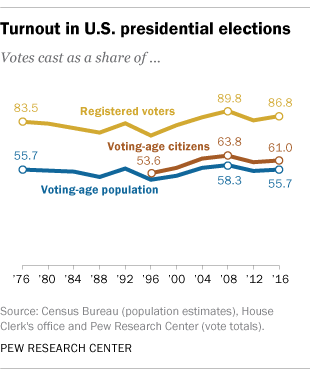
As a consequence, turnout comparisons based just on registered voters may not be very meaningful. For case, U.Due south. turnout in 2016 was 86.eight% of registered voters, fifth-highest among OECD countries and second-highest among those without compulsory voting. But registered voters in the U.Due south. are much more of a self-selected group, already more probable to vote because they took the trouble to register themselves.
There are even more means to calculate turnout. Michael McDonald, a political scientist at the University of Florida who runs the United States Election Projection, estimates turnout as a share of the "voting-eligible population" by subtracting noncitizens and ineligible felons from the voting-historic period population and calculation eligible overseas voters. Using those calculations, U.Due south. turnout improves somewhat, to 60.1% of the 2016 voting-eligible population. However, McDonald doesn't calculate comparable estimates for other countries.
No matter how they're measured, U.Due south. turnout rates have been fairly consistent over the past several decades, despite some election-to-ballot variation. Since 1976, voting-age turnout has remained within an 8.5 percentage betoken range – from just under fifty% in 1996, when Bill Clinton was reelected, to only over 58% in 2008, when Barack Obama won the White Business firm. Withal, turnout varies considerably amidst different racial, ethnic and age groups.
In several other OECD countries, turnout has drifted lower in recent decades. Hellenic republic has a compulsory-voting law on the books, though it'due south not enforced; turnout in that location in parliamentary elections fell from 89% in 2000 to 63.v% last year. In Kingdom of norway'southward most recent parliamentary elections, 2017, 70.6% of the voting-age population cast ballots – the lowest turnout rate in at to the lowest degree iv decades. And in Slovenia, a flare-up of enthusiasm followed the country's independence from Yugoslavia in 1992, when 85% of the voting-age population cast ballots – but turnout has fallen almost 31 percentage points in two-and-a-one-half decades of republic, sinking to 54.six% in 2018.
On the other hand, turnout in recent elections has bumped upward in several OECD countries. Canadian turnout in the two most recent parliamentary elections (2015 and 2019) topped 62%, the highest rate since 1993. In Slovakia's legislative elections this by February, nearly ii-thirds (65.iv%) of the voting-age population cast ballots, up from 59.iv% in 2016. And in Hungary's 2018 parliamentary elections, nearly 72% of the voting-age population voted, up from 63.three% in 2014.
Notation: This is an update of a post originally published May 6, 2015.

How Many Registered Voters Vote,
Source: https://www.pewresearch.org/fact-tank/2020/11/03/in-past-elections-u-s-trailed-most-developed-countries-in-voter-turnout/
Posted by: smithjould1995.blogspot.com
0 Response to "How Many Registered Voters Vote"
Post a Comment